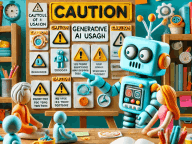
Gen-AI tools can significantly assist and enhance efficiency in learning and research. However, there are important things to keep in mind when using the results generated by these tools!
While many AI tools draw from vast amounts of reliable data, their "black box" nature can make it difficult to verify sources. AI-generated content may be biased or inaccurate due to training data disparities (e.g., more English data than Chinese, or more data from other regions compared to Taiwan). If you cannot verify the sources of generated content or the training data, you cannot guarantee its accuracy or appropriateness. Always maintain a healthy skepticism and independently verify the information.
[What you can do]
Consider using multiple, varied sources to cross-verify the data obtained from generative AI tools.
Generative AI tools are trained on vast amounts of data, but the legality of how this data was acquired is often debated. While these tools boost efficiency, their outputs may include unauthorized citations or copyrighted material. There are currently many lawsuits accusing AI companies of copyright infringement.
As copyright ownership of AI-generated content remains unclear and fair use principles are unstandardized, academia is actively developing guidelines. Users should carefully verify results and appropriately disclose their use of AI tools. Adhering to academic integrity is crucial for responsible research and mitigating legal risks.
[What you can do]
① Carefully verify generated results and disclose the extent to which AI tools were used.
② If submitting an article for publication, check the publisher's policies and restrictions on AI usage beforehand.
While AI tools can help explore topics, they are not academic databases or standard search engines. Even if trained on academic literature, generative AI is designed to "generate" new text, unlike databases that point you directly to primary literature and sources. Keep this key difference in mind.
[What you can do]
① Rely on actual academic databases or library discovery platforms when searching for peer-reviewed literature.
② Consider using AI tools developed by academic publishers (like Scopus AI), which are trained on their own verified databases and are far less likely to hallucinate or provide false information.
Because different AI tools use different language models, the recency and accuracy of their information vary. When searching for current events or recent developments, an AI tool is only as good as the cut-off date of its training data.
For example: On February 3, 2025, ChatGPT-4's latest training data was up to June 2024. Therefore, it would be unaware of any events between July 2024 and February 2025. On the same date, Microsoft Copilot had data updated up to January 23, 2025, offering a much more recent perspective.
[What you can do]
If data recency is critical to your research, use frequently updated academic databases like PubMed, Scopus, or Web of Science.
Everything you input into an AI tool might be used as future training data and could inadvertently resurface in responses to other users. You must handle personal and confidential information carefully to prevent data leaks or unauthorized access.
[What you can do]
① Be extremely cautious about what you type or upload. Never input sensitive, confidential, or proprietary information.
② Familiarize yourself with the privacy policies of the AI platforms you use to ensure compliance with academic ethics and data protection regulations.
Ethics of Artificial Intelligence: The Recommendation
Guide on the use of generative artificial intelligence
Generative artificial intelligence (AI) in education
Guidelines on Generative AI in Teaching and Academic Ethics
How to cite ChatGPT
→ Guidelines and Examples https://apastyle.apa.org/blog/how-to-cite-chatgpt
Key Points
★ AI cannot be listed as an author in APA academic publications.
★ Authors are fully responsible for the accuracy of any information in their papers.
How do I cite generative AI in MLA style?
→ Guidelines and Examples https://style.mla.org/citing-generative-ai/
Key Points
★ You must cite the AI tool whenever you paraphrase, quote, or incorporate any AI-generated content (text, images, data, etc.) into your work.
★ It is not recommended to treat AI tools as authors.
How to cite content generated or developed by AI (e.g., ChatGPT)
→ Guidelines and Examples
https://www.chicagomanualofstyle.org/qanda/data/faq/topics/Documentation/faq0422.html
Key Points
★ Do not cite ChatGPT in a bibliography or reference list unless you provide a publicly available link to the conversation.

No Code Website Builder